

Treatment Rooms in Asklepion in Kos
March 12, 2024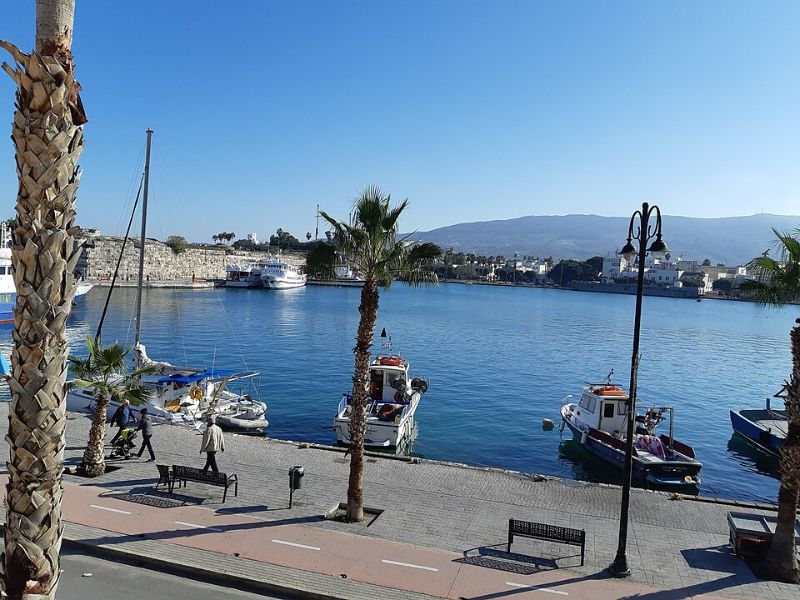
Table of Contents
Introduction
Kos Town does not announce its history loudly. It reveals it in fragments. A column base near a café. A worn stone path cutting across a busy square. You notice it almost without trying. And gradually, the presence of Hippocrates in Kos begins to feel less like a historical reference and more like something woven into the city’s everyday rhythm.
Here, the past is not framed behind barriers. It stands where life continues — in open spaces, along harbour walls, beneath trees that gather both shade and stories. Walking through the centre becomes an exercise in attention rather than observation.
The Legacy of Hippocrates in Kos
The walk often starts at the Plane Tree of Hippocrates. People gather there instinctively. Some pause for photographs. Others simply pass through. Tradition places Hippocrates teaching his students beneath a tree on this very site. Whether the exact spot is certain almost feels secondary.
The tree that stands today is centuries old, though not ancient enough to have witnessed those lessons firsthand. Still, the symbolism holds. Open-air teaching. Dialogue in public view. Knowledge shared without walls. In that sense, Hippocrates in Kos feels grounded in the physical space, not confined to statues or inscriptions.
A few steps away, the Gazi Hassan Mosque adds another chapter. Its presence does not interrupt the narrative; it extends it. Classical fragments, Ottoman architecture and present-day movement coexist in the same square. The layers are visible, but they do not compete. They simply remain.
Walking Through the Layers of Kos Town
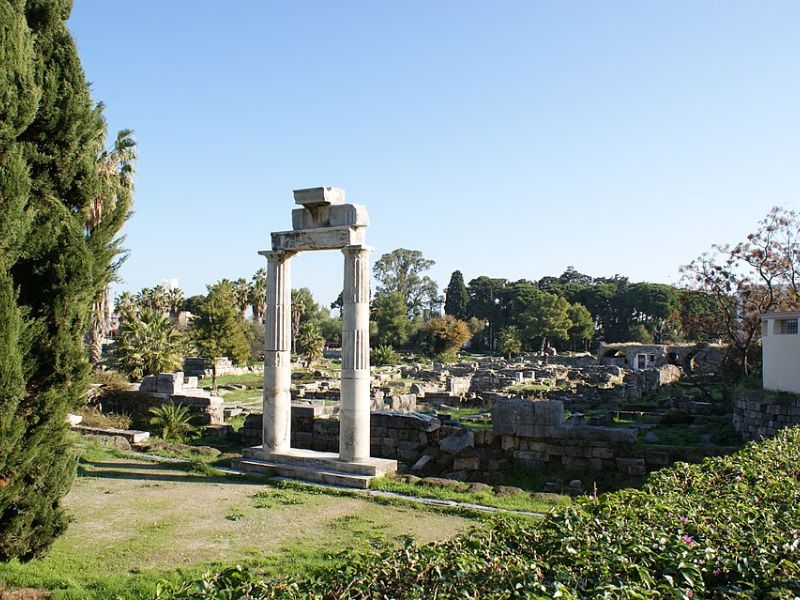
Leaving the square, the path opens into the Ancient Agora. The shift is subtle but noticeable. The space feels exposed, almost unfinished. Columns lie where they once stood. Foundations outline structures that no longer rise.
This was the civic core of ancient Kos — a place of exchange, trade, conversation. There are no dramatic reconstructions guiding your imagination. Instead, the site asks you to fill the silence yourself. In moments like this, the legacy of Hippocrates in Kos connects naturally to the civic life that once unfolded here. Medicine, debate, philosophy — all rooted in shared space.
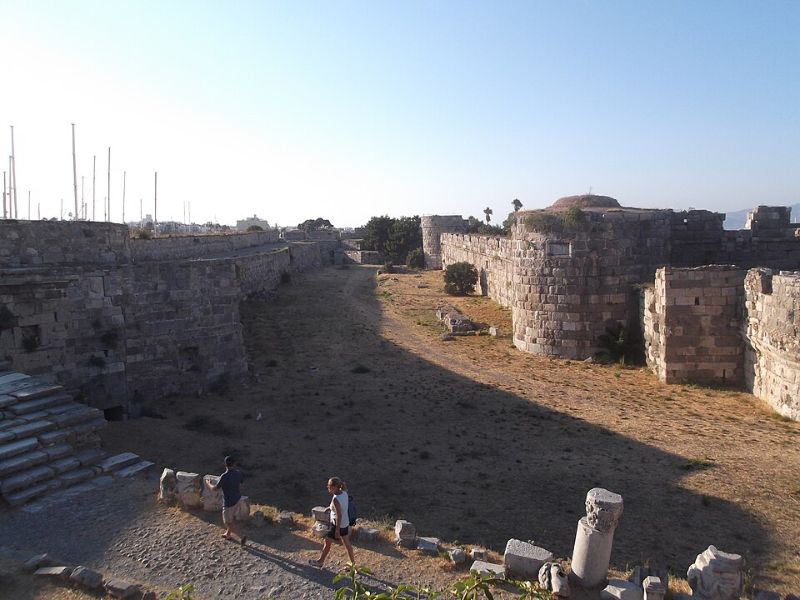
Closer to the harbour, the Castle of Neratzia changes the tone again. Its walls are solid, defensive, purposeful. Built by the Knights of Saint John, it reflects an era defined less by intellectual pursuit and more by protection and control of the sea.
The contrast matters. Kos has been shaped by ideas, but also by strategy. By healing and by defence. Seeing both within a short walk shifts the way the island’s history feels — less linear, more layered.
From there, the harbour promenade brings you back into the present. Conversations spill from cafés. Boats move slowly across the water. The change is not abrupt. It feels like a continuation rather than a break.
Conclusion
Returning to the Plane Tree, the route feels different than it did at the beginning. What seemed like separate landmarks now connect into a single narrative. Hippocrates in Kos becomes more than an association with medicine. It becomes a perspective — a way to read the city.
Kos Town does not isolate its past. It allows it to stand within daily life, unchanged in some places, adapted in others. Exploring Hippocrates in Kos is not simply a historical walk. It is an encounter with continuity — where knowledge, architecture and ordinary movement share the same ground.


